
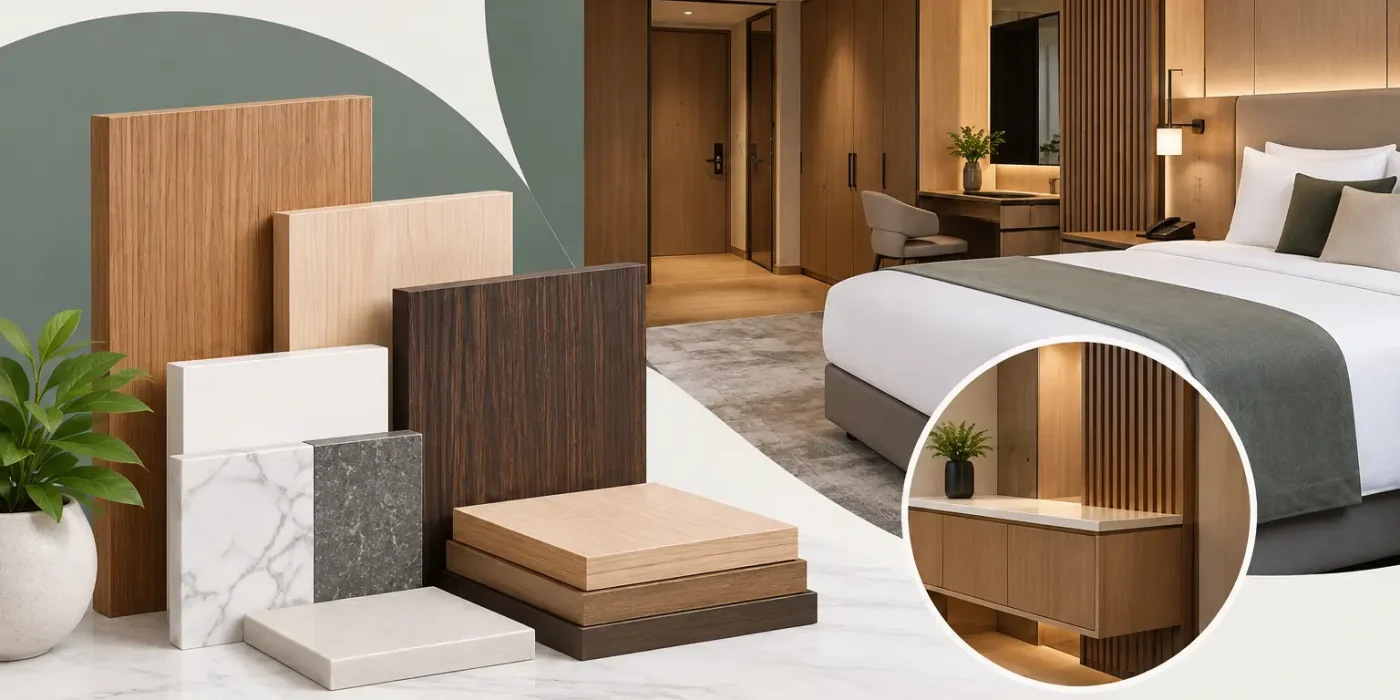
A hotel lobby desk can look exceptional at handover and still become a maintenance issue within a year. Luggage impacts corners, cleaning teams use chemical products, guests rest bags against panels, and staff operate the joinery continuously. Selecting the best materials for hotel millwork is therefore not simply a design decision. It is a technical coordination exercise that affects guest experience, operating cost, fabrication quality, approval timelines, and the service life of the interior.
For hotel fit-out teams, the right answer is rarely one material across every space. A material that performs well in a low-contact guestroom wardrobe may be unsuitable for a wet bar, a high-traffic buffet counter, or a fire-rated corridor door surround. The most reliable specifications balance visual intent with substrate stability, edge protection, moisture resistance, cleaning requirements, code compliance, and available budget.
What Determines the Best Materials for Hotel Millwork?
Hotel millwork is exposed to more demanding conditions than many residential interiors. Public areas receive constant traffic, guestroom furniture faces repeated use and frequent cleaning, and back-of-house joinery must prioritize practical durability over decorative complexity. The material selection should respond to the use of each element, not only its appearance in a sample board or rendering.
The key questions should be established before shop drawings begin. What level of impact will the item receive? Is it near water, steam, food service, or direct sunlight? Does the surface require frequent chemical cleaning? Will the finish need to be repaired locally if damaged? Is the detail subject to fire, acoustic, or accessibility requirements?
These decisions need to be visible in the documentation. A general note such as “wood veneer finish” leaves too much open to interpretation. Fabricators and site teams need clear information on the substrate, veneer species and cut, finish system, grain direction, edge treatment, backing material, thickness, and interface with adjacent finishes.
Veneer-Faced Plywood for Premium Public Areas
Veneer-faced plywood remains one of the strongest choices for feature joinery, wall paneling, reception desks, and high-end guestroom furniture. It provides the visual depth of natural timber while offering better structural stability than solid wood for large panels and fabricated components.
Its main advantage is that it can accommodate a wide range of detailing. Curved elements, book-matched panels, concealed access doors, shadow gaps, and integrated metal trims can all be resolved effectively when the plywood grade and veneer layup are properly coordinated. In luxury hospitality projects, veneer also creates a level of material character that laminate cannot fully replicate.
There are trade-offs. Natural veneer varies in tone and grain, so mockups and control samples are essential. Veneered surfaces also require an appropriate clear coat or stain system to resist scratches, cleaning products, and color change. For reception counters and other contact-heavy elements, the design should include durable stone, metal, solid surface, or compact laminate at the most vulnerable horizontal surfaces rather than relying on veneer alone.
Decorative Laminates for Consistent, Durable Finishes
High-pressure laminate and melamine-faced boards are practical materials for much of a hotel’s guestroom and service-area millwork. They provide consistent color and pattern, predictable lead times, and relatively straightforward replacement when a panel is damaged. For wardrobes, minibar units, luggage benches, housekeeping storage, and staff areas, laminates can deliver a controlled appearance at a commercially sensible cost.
High-pressure laminate is generally better suited to demanding applications because it offers stronger resistance to wear, staining, and impact than standard melamine finishes. It is often appropriate for vanity cabinetry, corridor service cabinets, restaurant host stations, and millwork exposed to frequent use.
The performance of laminate joinery depends heavily on the edges. Exposed board cores at poorly sealed edges are a common source of swelling and finish failure, particularly near sinks, ice stations, and cleaning areas. Shop drawings should identify edge band thickness, color matching, corner radii, substrate type, and the required treatment at cutouts. A thin edge band may be acceptable inside a wardrobe, but it is unlikely to withstand repeated trolley or luggage contact in public areas.
Moisture-Resistant Boards Where Water Is a Real Risk
Moisture-resistant MDF, moisture-resistant particleboard, exterior-grade plywood, and cement-based boards each have a place in hotel interiors, but they are not interchangeable. The selected board must match the exposure condition.
Moisture-resistant MDF provides a smooth surface for painted panels, routed profiles, and decorative moldings. It is useful for dry or moderately humid interior locations where a refined painted finish is required. However, it should not be treated as waterproof. If water enters an unprotected joint, penetrates a service cutout, or sits against the base of a panel, failure can still occur.
For wet zones, exterior-grade plywood is often a more dependable substrate, particularly behind veneer, laminate, or solid surface finishes. In shower-adjacent cabinetry, spa facilities, poolside service areas, and high-moisture back-of-house spaces, cement-based boards or purpose-designed waterproof systems may be more suitable. The substrate, adhesive, sealant, and fixing method must all be considered together. A water-resistant board alone cannot compensate for poor junction detailing.
Solid Surface for Vanities, Counters, and Hygiene-Critical Areas
Solid surface is a highly effective choice for bathroom vanities, concierge counters, buffet stations, and other areas where hygiene, visual continuity, and repairability matter. It can be fabricated with inconspicuous joints, integrated basins, coved upstands, and shaped edge profiles. This reduces dirt-trapping lines and supports easier housekeeping.
Unlike many decorative finishes, solid surface can often be refinished after light scratches or stains. That makes it valuable in hotel environments where surfaces must retain their appearance through continuous cleaning cycles. It also allows designers to create monolithic forms that would be difficult to execute in stone or laminate.
Its limitations are cost and heat resistance. Solid surface is usually more expensive than laminate-based construction, and hot objects can mark the material if protection is not provided. It is best used selectively on high-visibility or hygiene-sensitive components rather than as a default finish for every countertop.
Natural Stone and Sintered Surfaces for High-Impact Locations
Natural stone brings weight, permanence, and premium character to reception desks, bar fronts, vanity tops, and elevator lobbies. Sintered stone and porcelain slabs offer many of the same visual advantages with strong resistance to heat, staining, and abrasion. These materials are particularly effective where the hotel concept calls for large-format surfaces with minimal visual interruption.
The detailing is critical. Stone requires adequate structural support, carefully coordinated slab joints, tolerances for movement, and protection at vulnerable exposed corners. Its weight affects the joinery carcass, subframe, transport, and installation sequence. Sintered materials can be thinner and lighter, but they still require experienced fabrication and appropriate support at cutouts and cantilevers.
A drawing package should clearly identify the slab thickness, finish, edge profile, joint arrangement, support system, and interface with timber or metalwork. Without this level of coordination, attractive material selections can become site adjustments with avoidable cost consequences.
Metals, Glass, and Upholstery Are Part of the Millwork System
Hotel millwork rarely consists of board material alone. Metal trims protect exposed corners, define shadow gaps, reinforce shelving, and add a premium visual layer. Stainless steel is suitable for wet or food-service conditions, while powder-coated steel, brass, bronze, and aluminum can support a specific design language in dry public areas.
Glass may be used for display cabinets, shelving, wardrobe doors, and decorative screens, but its thickness, safety specification, fixing method, and tolerance must be coordinated early. Upholstered panels and integrated seating add acoustic softness and comfort, yet they require commercial-grade fabrics, suitable foam densities, stain resistance, and accessible replacement strategies.
These interfaces are where millwork packages often fail if they are not fully detailed. A metal trim cannot simply be shown as a line on an elevation. It needs a section, fixing logic, finish reference, return dimension, and clear responsibility for fabrication and installation.
Specify by Zone, Not by Finish Board
A practical hotel material strategy divides the project into performance zones. Guestroom wardrobes and desks may prioritize cost control and consistent laminate finishes. Guestroom vanities require moisture-tolerant construction and durable countertop materials. Reception counters, restaurant stations, and elevator lobbies justify higher-grade veneers, stone, metals, or solid surfaces because they carry the strongest guest-facing impact.
Back-of-house joinery should focus on cleanability, impact resistance, and efficient replacement. In contrast, a signature lounge or executive-floor arrival area may justify complex veneer matching, curved plywood forms, integrated lighting, and custom metalwork. The budget should follow the operational and visual priority of each zone.
This approach also improves value engineering. Rather than reducing every material specification, teams can retain premium finishes at focal points and select more durable, efficient materials where guests are less likely to notice the difference. The result is a more coherent hotel interior and better control of lifecycle cost.
Turn Material Intent Into Fabrication-Ready Information
Material quality is only as reliable as the information provided to the manufacturer. Accurate shop drawings should coordinate material build-ups, finish codes, grain direction, panel sizes, access requirements, hardware, backing boards, edge treatments, and site interfaces. They should also identify where mockups, samples, and approval hold points are required before production.
For hotel fit-out projects, Design Studio LLC develops coordinated joinery and fit-out documentation that translates these decisions into clear fabrication and installation requirements. This level of precision helps architects, designers, contractors, and joinery manufacturers identify conflicts before materials are ordered or work reaches site.
The best material is not necessarily the most expensive one. It is the one that performs as intended in its exact location, can be detailed and fabricated correctly, and continues to support the hotel’s standards after thousands of guest interactions. A well-coordinated material schedule and drawing package give that decision its best chance of succeeding on site.